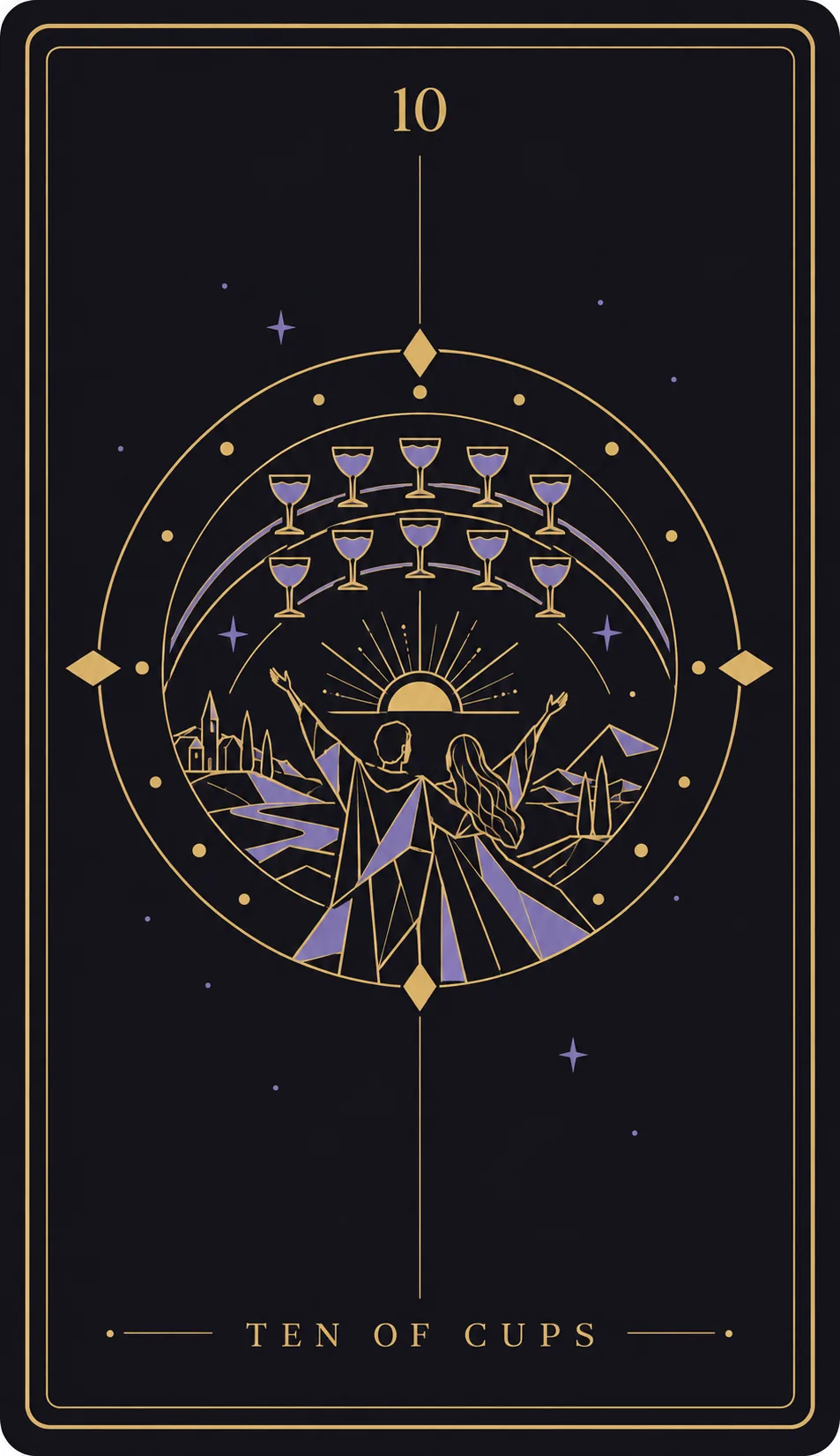
Ten of Cups
- Number
- 10
- Arcana
- Minor Arcana
- Suit
- Cups
- Element
- Water
Upright keywords
- harmony
- family
- emotional fulfilment
- belonging
Reversed keywords
- disconnection
- misaligned values
- family tension
Ten of Cups upright
In the classic 1909 Pamela Colman Smith deck, a couple stands with arms raised beneath a rainbow of ten cups, two children dancing beside them, a small house on the hill behind. Nobody is holding a cup. The abundance is in the air, shared rather than owned, and that is the heart of this card: belonging you don't have to earn.
Drawn upright, the Ten of Cups can point to a stretch where your emotional life feels broadly in step with your daily one. Water is the suit's element, and here it has settled into something calm enough to reflect the sky. You may notice gratitude arriving unprompted — in a kitchen, a group chat, an ordinary evening. It might be worth naming what you already have before reaching for more.
Ten of Cups reversed
Reversed, the rainbow in this card can feel painted on rather than real. The picture of harmony is still there, but something underneath doesn't match it — the family dinner everyone performs through, the friendship you keep up out of habit, the life that looks right on paper and sits oddly in your chest.
This position may point to disconnection rather than disaster. Sometimes it suggests values that have quietly drifted apart: what you want from closeness is no longer what the people around you want, and nobody has said so out loud. Water turned inward can also mean you're holding feeling in to keep the peace. It might be worth asking which version of contentment you're protecting, and whether it's actually yours.
Ten of Cups in love
The Ten of Cups speaks less about romance's first spark and more about what happens after — the long, unglamorous work of building something you can relax inside. Notice that the figures in the classic image face the rainbow together rather than each other. Shared direction matters as much as shared feeling here.
Drawn for love, this card can point to a connection where you feel genuinely seen by the people in it, whether that's a partner, close friends, or chosen family. You may find small rituals carry more weight than grand gestures: the standing Sunday call, the walk you always take together. It may also be asking about your relationship with yourself — whether you offer yourself the same warmth you extend so easily outward.
Ten of Cups at work
Water isn't the obvious element for working life, and that's part of what this card brings to it. The Ten of Cups asks less about achievement and more about whether the work sits well with you emotionally — whether you like the people, whether the goal still resembles something you'd choose.
Drawn for work or study, it can suggest a period where a team feels genuinely collaborative, or a project finally aligns with why you started. The house on the hill in the classic image is modest; it's a life, not an empire. You may want to notice which colleagues make the day lighter, and what your work actually serves beyond itself. If something feels hollow despite looking successful, that feeling is worth listening to rather than overriding.
Ten of Cups and your inner life
The rainbow in this card appears after rain, not instead of it. That detail matters for inner work: the Ten of Cups rarely describes a life without difficulty, but one where you've found enough connection to hold the difficult parts. Water teaches by flowing toward what's lower and shared rather than what's highest.
Drawn for yourself, this card can invite you to widen your sense of belonging — to notice how much of your contentment is relational, and how much you've been trying to generate alone. You may find it useful to tend the ordinary bonds you take for granted.
A gentle question: *when did you last feel completely at ease in someone's company, and what made that possible?* See if any small part of it can be repeated this week.
Ten of Cups as a yes or no
This card leans yes, and warmly so. The imagery itself is one of the most unreserved in the classic deck — arms open, children dancing, cups arranged in a rainbow rather than clutched or counted. Nothing in the scene is guarded or withheld, which makes it a gentle affirmative for questions about belonging, reconciliation, commitment and shared plans.
Worth noting, though: the yes it offers is an emotional one rather than a practical one. It speaks to whether something will feel right, not whether the logistics will fall neatly into place. If your question is about happiness, closeness or whether people are on the same page, the leaning is encouraging. Hold it as a direction to reflect on rather than a verdict already delivered.
Tarot is for reflection and entertainment. It isn't medical, legal or financial advice.
Draw a card for your question
Hold your question in mind and draw one card. It's free, truly random and takes a minute.
Draw your card