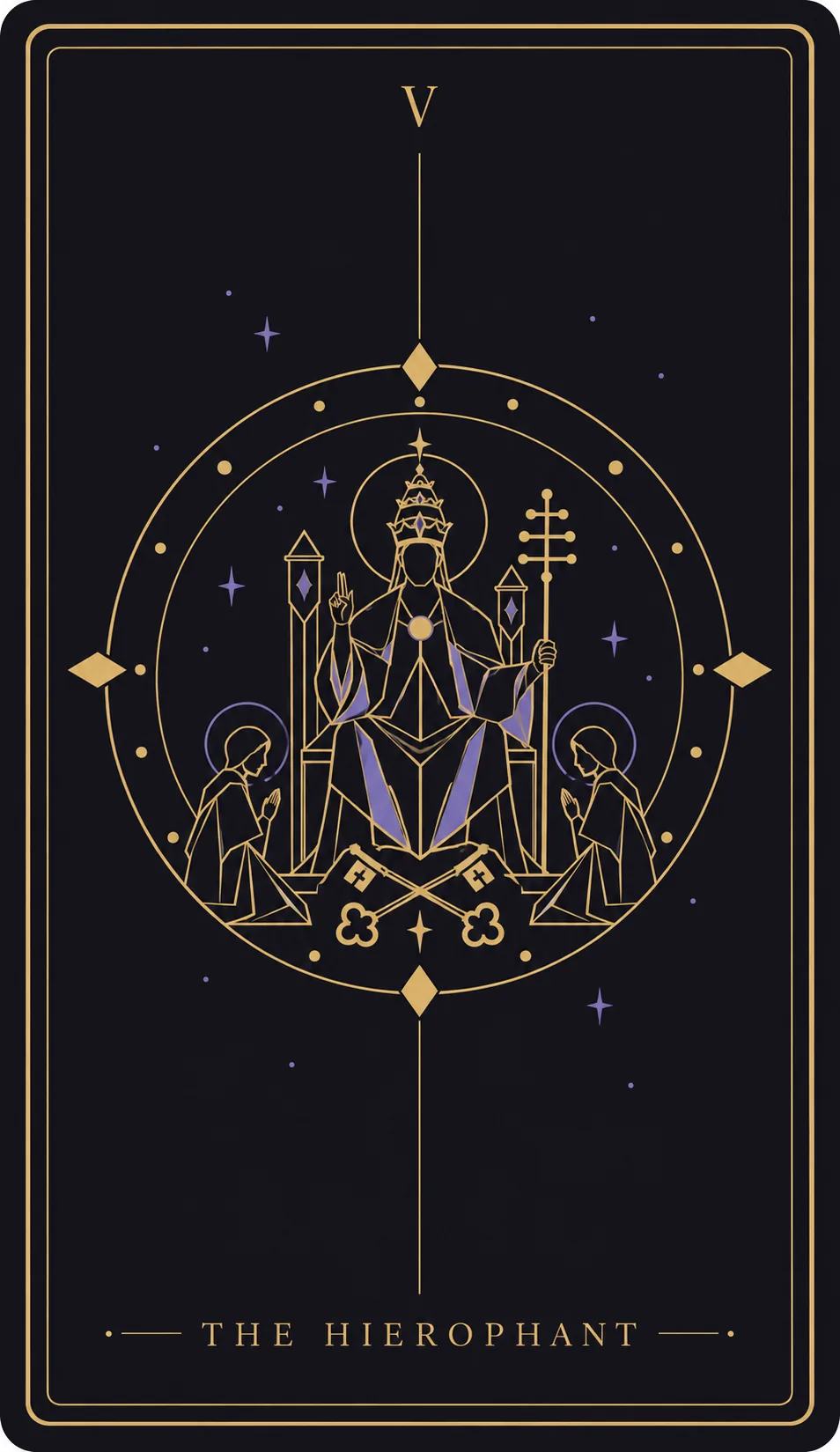
The Hierophant
- Number
- V
- Arcana
- Major Arcana
- Element
- Earth
Upright keywords
- tradition
- guidance
- belonging
- learning
Reversed keywords
- rebellion
- dogma
- unconventional paths
The Hierophant upright
In the classic 1909 Pamela Colman Smith deck, the Hierophant sits between two stone pillars, one hand raised in blessing, two attendants kneeling before him while crossed keys rest at his feet. He belongs to earth: structure, institution, things built slowly and handed down. Drawn upright, this card can point to a moment when you're drawn toward something established — a teacher, a tradition, a community with its own rituals and vocabulary. You may notice a wish to be taught rather than to figure it all out alone, or to belong somewhere with rules you didn't invent. It might be worth asking which inherited structures still serve you and which you keep simply because they're familiar. The keys suggest access, but someone has to hand them over.
The Hierophant reversed
Reversed, the Hierophant's steady earth can tip in several directions. You may notice yourself chafing against a rule, a family expectation, or an institution that once felt like home — the pillars starting to look more like walls. That restlessness isn't necessarily a problem to fix; it can be information about how much you've grown. The card can also point the other way: a belief held so tightly it stopped being examined, or advice taken from an authority because they sounded certain rather than because it fit you. The two kneeling attendants in the classic image are listening to someone else's words. Reversed, it might be worth asking whether you'd still choose this teaching if you met it today, as the person you are now.
The Hierophant in love
The Hierophant's earth element speaks to relationships that take visible form: shared routines, meeting the family, the quiet agreements about how you do holidays and Sundays. Drawn for love, it can point to a wish for something recognised and steady, or to a moment when you and someone else are negotiating whose traditions win. You may notice a pull toward commitment with structure around it, or a relief at knowing where you stand. With friends, it can describe the group that has its own rituals, the ones who hold a place for you. With yourself, consider which rules about love you absorbed early and never questioned. One small thing to try: name one ritual you'd like to keep, and one you'd happily retire.
The Hierophant at work
With its feet planted in earth, the Hierophant often shows up around learning, mentorship and institutions. You may be entering somewhere with established ways of doing things — a course, a new team, a field with its own language — and finding that the fastest path is to learn the form before bending it. This card can also point to your own turn as the one who explains, trains or holds standards for others. The crossed keys at the figure's feet suggest knowledge that gets passed hand to hand rather than invented alone. It might be worth asking who you'd genuinely like to learn from right now, and whether you've actually asked them. Apprenticeship is slow, but earth cards rarely reward rushing.
The Hierophant and your inner life
The Hierophant is an earth card about inherited frameworks: the beliefs, sayings and shoulds you absorbed before you could evaluate them. In the classic image, the figure's hand is raised in blessing while two attendants kneel below, already arranged in a hierarchy. Drawn for inner work, it can invite you to sort through what you were taught — not to throw it all out, but to see clearly which pieces you'd choose again. Some traditions hold real weight and comfort; others are just old furniture you've stopped noticing. As a practice this week, write down three rules you live by without thinking, and beside each one note where it came from. Then sit with this: *which of these still fits the person I'm becoming?*
The Hierophant as a yes or no
The Hierophant leans toward a cautious yes, with conditions attached. This is a card of established paths and approved routes, so it tends to favour the choice that follows the proper process — the formal application, the recognised qualification, the conversation with the person who actually holds the keys. If your question involves working within a system or getting someone's blessing, the lean is encouraging. If it involves improvising, skipping steps or going around an authority, this card is less enthusiastic; the figure in the classic image sits very still between two heavy pillars. Earth moves slowly. So read this as a yes that comes with paperwork and patience rather than a sudden green light, and consider whether you have the appetite for that.
Tarot is for reflection and entertainment. It isn't medical, legal or financial advice.
Draw a card for your question
Hold your question in mind and draw one card. It's free, truly random and takes a minute.
Draw your card