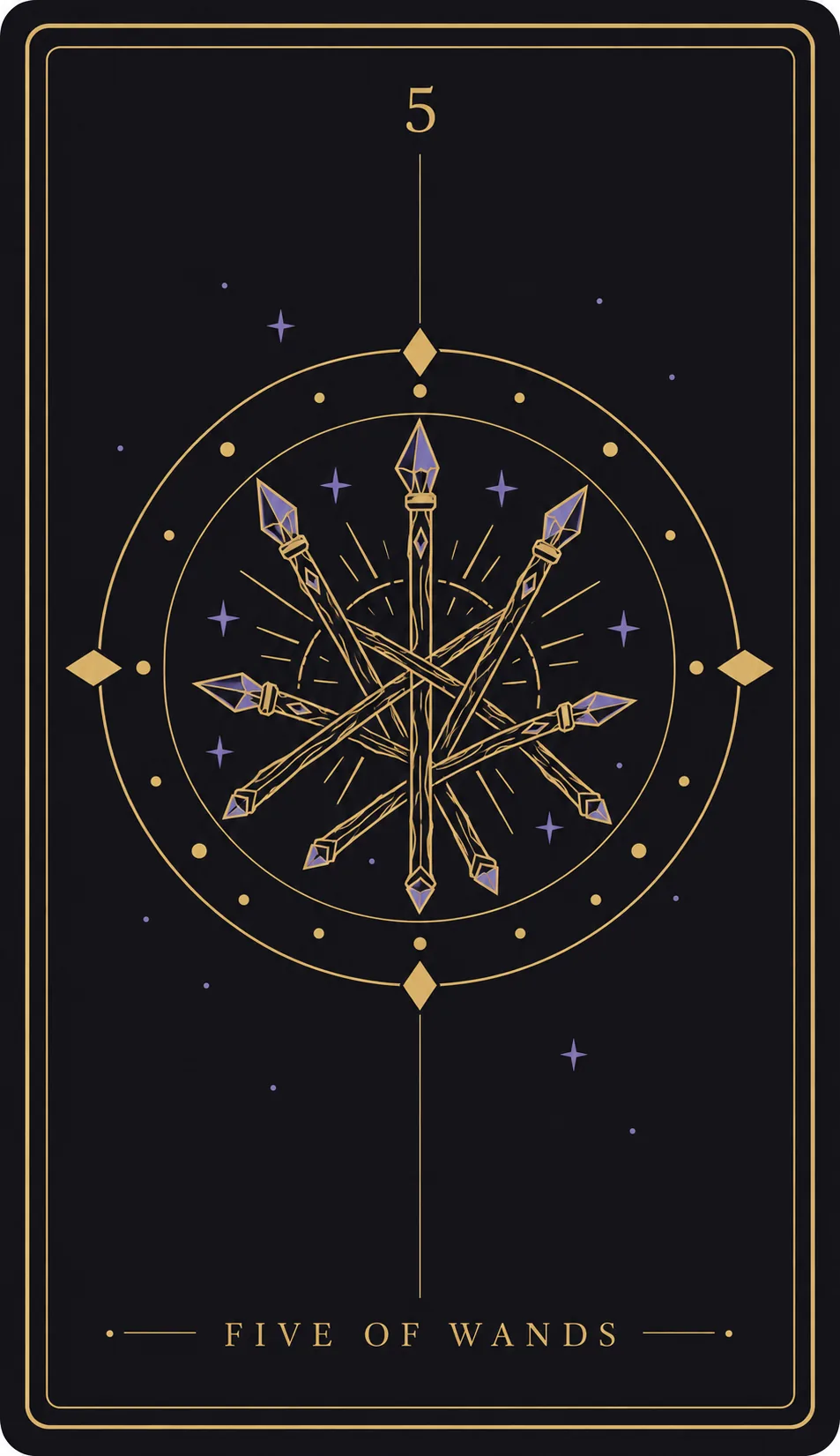
Five of Wands
- Number
- 5
- Arcana
- Minor Arcana
- Suit
- Wands
- Element
- Fire
Upright keywords
- conflict
- competition
- tension
- disagreement
Reversed keywords
- avoiding conflict
- resolution
- inner conflict
Five of Wands upright
In the classic 1909 Pamela Colman Smith deck, five young figures brandish staves in what looks less like a battle than a scuffle, everyone swinging at once, nobody landing a decisive blow. There's no blood here, just noise. As a card of fire, the Five of Wands can point to friction that comes from too much energy in one room: five people with five good ideas, all talking over each other.
You may notice this in a group chat that keeps misfiring, a team where everyone wants to lead, or a household negotiating whose plans matter this weekend. The card rarely suggests real enmity. It might be worth asking whether the tension you're feeling is hostility or simply unorganised enthusiasm, and whether anyone has actually said out loud what they want.
Five of Wands reversed
Reversed, the staves in the classic image seem to lower, or else the whole struggle turns inward where no one can see it. This can point to conflict you're swallowing: the comment you decided not to make, the disagreement you smoothed over because the argument felt more expensive than the compromise. Fire banked rather than burning.
Sometimes this is genuine resolution, the scuffle ending because people finally heard each other. Sometimes it's avoidance that costs you something quiet. And sometimes the fight has simply moved inside, two parts of you wanting different things with equal conviction. You may find it useful to ask which version is true right now, and whether there's one small thing you've been declining to say that could be said gently.
Five of Wands in love
The Five of Wands in matters of closeness often describes the bickering phase rather than the breaking phase. Think of the five figures in the classic deck, swinging their staves without anyone getting hurt: the recurring argument about whose turn it is, the friend group where two people compete for the same attention, the dating stretch where you feel like one of several.
Fire wants expression, and conflict here can be a sign that something real is being negotiated rather than quietly resented. You might notice that the same disagreement keeps returning in different costumes. It could be worth naming the pattern aloud with warmth rather than scoring the next round, or asking yourself what you actually want underneath the position you're defending.
Five of Wands at work
At work or in study, this card can describe a crowded field: several people pitching at once, a team where roles overlap, a course where everyone's ambition raises the temperature. The five figures in the classic image aren't enemies so much as competitors who haven't agreed on the rules yet. Fire is generative here, even when it's uncomfortable.
You may find that the friction is actually useful, sharpening an idea that would have stayed soft in a quieter room. It might be worth asking whether you're competing for something you genuinely want, or just reacting to someone else's pace. A small, concrete action: clarify who is responsible for what, in writing if you can. Much of this card's noise comes from undefined edges.
Five of Wands and your inner life
The Five of Wands can arrive when your inner life is unusually crowded. Fire doesn't sit still, and you may notice several wants pulling at once: the part of you that craves rest and the part that craves momentum, the version that wants to be liked and the version that wants to be honest. Like the figures in the classic image, they're all swinging, none of them winning.
There's no need to declare a victor today. A gentle practice: write down the two or three voices currently arguing, give each one a sentence to state its case, and notice which one you've been refusing to hear. The question worth sitting with is simply, *what is this conflict trying to protect?*
Five of Wands as a yes or no
This card leans toward *not yet*. The five figures in the classic deck are mid-scuffle, staves crossed in the air, and nothing has resolved. A yes usually arrives when the field is clear; here it's still crowded with competing voices, unsettled roles and energy that hasn't found its direction. Fire at this stage is heat without a hearth.
That isn't a refusal. It may simply suggest that the question is premature, that other people are still working out their own positions, or that you'd be answering in the middle of noise rather than from the quiet after it. You might take it as an invitation to ask what would need to be settled, and by whom, before a clearer answer could form.
Tarot is for reflection and entertainment. It isn't medical, legal or financial advice.
Draw a card for your question
Hold your question in mind and draw one card. It's free, truly random and takes a minute.
Draw your card