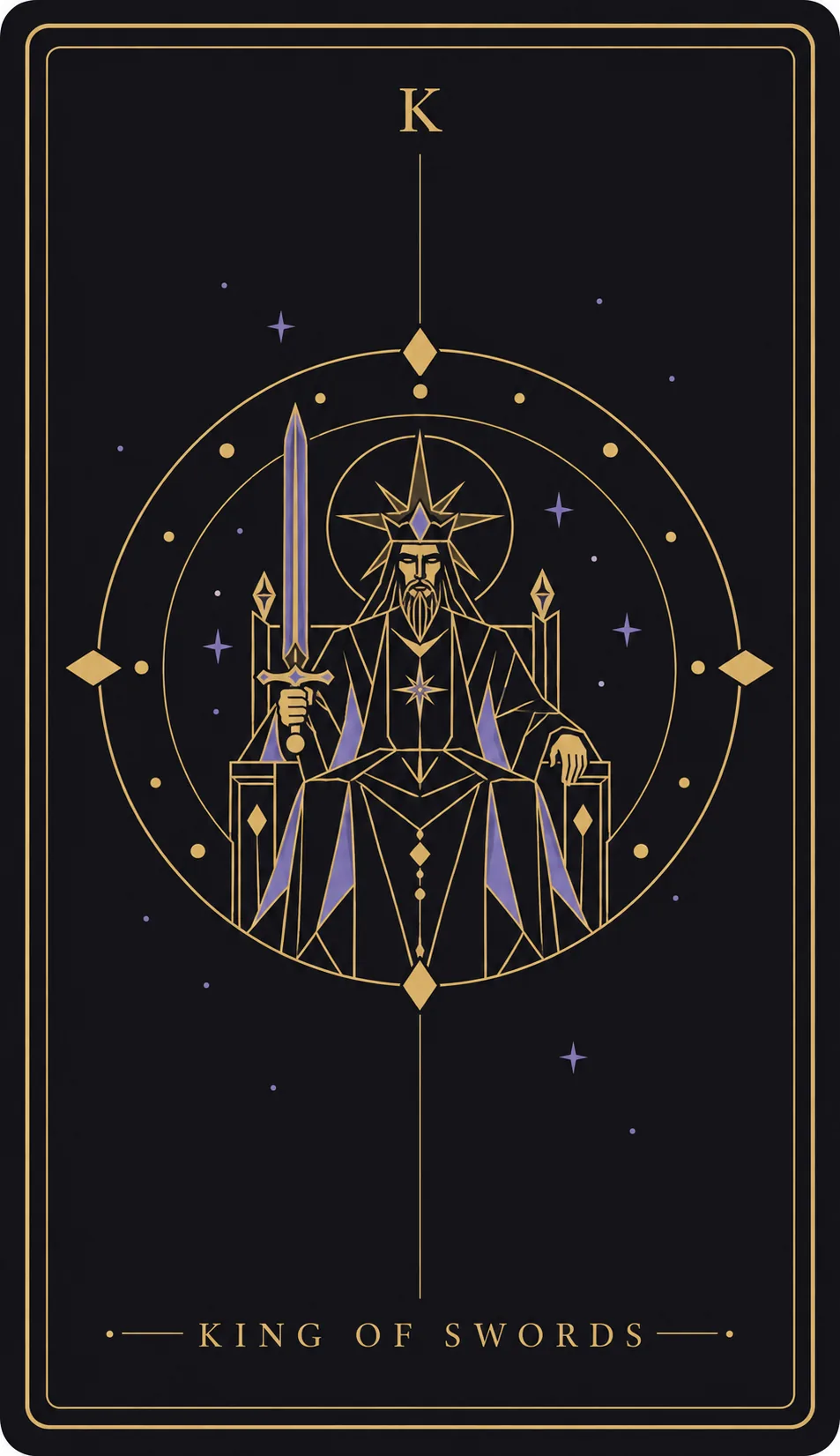
King of Swords
- Number
- King
- Arcana
- Minor Arcana
- Suit
- Swords
- Element
- Air
Upright keywords
- intellect
- authority
- truth
- clear thinking
Reversed keywords
- manipulation
- rigidity
- misuse of power
King of Swords upright
In the classic 1909 Pamela Colman Smith deck, the King of Swords sits face-on, upright sword in his right hand, the other hand resting almost like a fist. Butterflies and a thin line of clouds mark his throne; the air behind him is clear. As a king of the suit of air, he stands for thinking that has been tested and found steady.
Drawn upright, this card can point to a moment when clarity matters more than comfort. You may notice yourself wanting the plain version of a situation rather than the kind one. It might be worth asking what you actually know, what you have assumed, and where the line between them sits. Writing the facts in one column and your interpretations in another is a small, oddly grounding exercise.
King of Swords reversed
Reversed, the King of Swords can suggest that sharp thinking has turned on itself or on other people. The sword that once cut through confusion may now be used to win arguments rather than understand them. You might recognise this as replaying a conversation at night, assembling the perfect devastating reply that you will never actually say.
It can also show up as rigidity: a position held long past the point where it still fits, because changing your mind feels like losing. Or as someone nearby using logic and certainty as a kind of pressure. Air, when it stops moving, goes stale. It might be worth asking which of your current opinions you have genuinely reconsidered lately, and what it would cost you to say *I was wrong about that*.
King of Swords in love
The King of Swords in matters of closeness can point to honesty as a form of care. In the classic deck he looks straight ahead, not away, and that direct gaze is the gift here: saying what you actually mean, hearing what is actually said, instead of circling.
Still, this is an air king, and air can go cool. You may notice a tendency to analyse a relationship rather than feel your way through it, or to answer a partner's hurt with a reasonable explanation when they wanted warmth. With friends, it can suggest being the one people bring their tangles to. With yourself, it might be worth asking whether you hold yourself to a standard you would never impose on someone you love.
King of Swords at work
At work or in study, the King of Swords can point to the moment when you are asked to think clearly and say so out loud. He holds the sword upright, not raised to strike: authority here comes from having done the reading, not from volume. You may find yourself in a position where your judgement is genuinely wanted, even if it does not feel that way yet.
This card can also suggest cutting through a muddle. If a project has grown vague, it might be worth writing down the actual question in one sentence and seeing what falls away. Air likes structure and distinctions. A small practice: before the next meeting, decide what you believe and why, so you are not improvising a position under pressure.
King of Swords and your inner life
The King of Swords invites a particular kind of inner honesty: the sort that is calm rather than harsh. In the classic deck his throne is carved with butterflies, old symbols of transformation, sitting just behind a man who looks utterly unmoved. That contrast is worth noticing. Clear thinking is not the same as being unchangeable.
You may be in a season where you want to understand your own patterns rather than simply endure them. Naming things accurately can bring real relief. A gentle question to sit with this week: *where am I defending a conclusion instead of looking at it?* If you want a practice, pick one belief about yourself, write it down, and list what evidence you would need to revise it.
King of Swords as a yes or no
The King of Swords leans toward yes, but a conditional one: yes, if the reasoning holds. He sits with the sword raised straight and the sky cleared of all but a thin band of cloud, which suggests the situation can be seen plainly once you look. This is not a card of lucky outcomes; it is a card of sound judgement.
So rather than a flat answer, treat it as a prompt. If you can explain your choice to someone neutral in a few sentences and it still sounds right, the card tilts yes. If the explanation keeps needing extra clauses to work, that hesitation is worth more attention than any card. Air asks for honest thought before it offers agreement.
Tarot is for reflection and entertainment. It isn't medical, legal or financial advice.
Draw a card for your question
Hold your question in mind and draw one card. It's free, truly random and takes a minute.
Draw your card