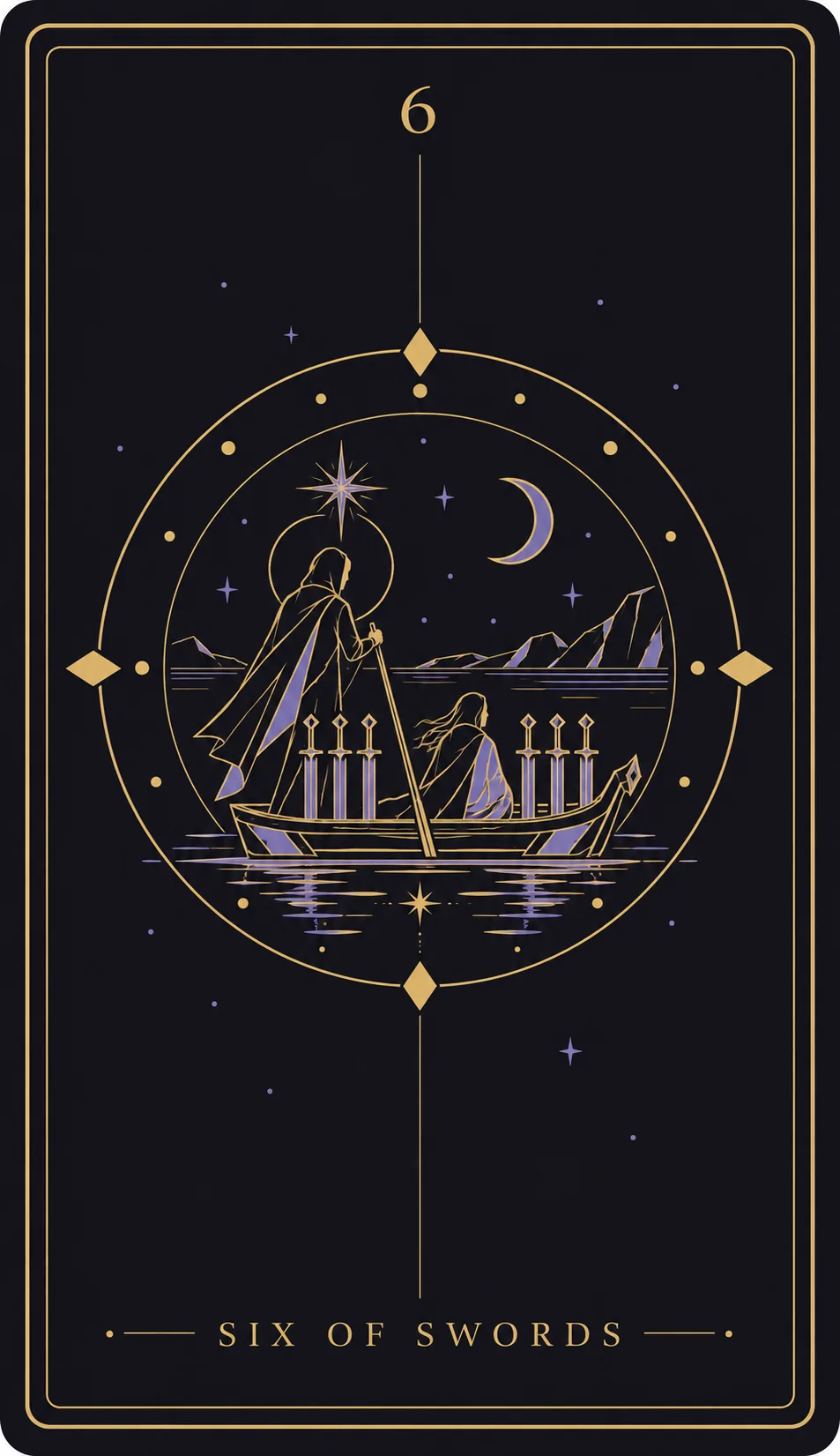
Six of Swords
- Number
- 6
- Arcana
- Minor Arcana
- Suit
- Swords
- Element
- Air
Upright keywords
- transition
- leaving the past behind
- calmer waters
- journey
Reversed keywords
- resistance to change
- unfinished business
- feeling stuck
Six of Swords upright
In the classic 1909 Pamela Colman Smith deck, a ferryman poles a small boat across grey water, a cloaked figure and a child seated with their backs to us, six swords standing upright in the hull. The water ahead is calm; behind, it was choppy. This is a card of air, the element of thought, and it often points to the moment when thinking shifts from churning to simply moving.
Drawn upright, it can suggest you are partway through a transition rather than at its beginning or end. You may notice that something painful has stopped being urgent, even if it still aches. The swords travel with you; you haven't erased what happened. It might be worth asking what you're carrying on purpose, and what simply came along in the boat.
Six of Swords reversed
Reversed, the boat seems to stall midstream. This can show up as a move you keep postponing, a conversation you rehearse but never have, or a version of the story you retell because telling it feels safer than leaving it. The air element turns in circles here: analysis instead of motion.
It may also point to unfinished business that genuinely needs attention before you can go anywhere. Sometimes staying put isn't avoidance, it's waiting for something to settle. You might ask yourself which it is. A small, concrete step often helps more than a decision: writing one email, packing one box, naming one thing out loud to someone you trust. The crossing doesn't have to happen all at once.
Six of Swords in love
This card can speak to relationships that are quietly changing shape. You may be moving away from a painful pattern with someone, or carrying a connection into gentler territory after a hard stretch. Notice that the figures in the boat travel together without speaking. Some repair happens in shared silence and ordinary routines rather than in big conversations.
If you're grieving a relationship, the Six of Swords doesn't rush you. It suggests the sharpest part may be behind you, even when the sadness lingers. With friends, it might point to who stayed in the boat when things got rough. And with yourself, it could invite a softer internal voice than the one you used during the storm. What would travelling kindly look like today?
Six of Swords at work
The Six of Swords often turns up around handovers, relocations, course changes and the slow middle of a project. You may have left one role, team or way of working and not yet arrived at the next shape of things. That in-between can feel oddly flat, which is sometimes what calmer water feels like after a stressful period.
Air is the element of ideas and communication, so this card can reward clear, unglamorous steps: documenting what you know, tying off loose threads, telling people where things stand. The swords are packed, not abandoned. Whatever skill or hard lesson you gained in the difficult stretch travels with you. It might be worth naming one thing you learned that you want to bring into the next chapter.
Six of Swords and your inner life
There's a quiet dignity in the ferryman's figure: he doesn't hurry, he just keeps the boat moving. This card can invite you to let a transition take the time it takes. You may be between versions of yourself, no longer who you were in the hardest moment, not yet settled into who comes next. That unfinished feeling is not a failure of progress.
Air asks you to think clearly rather than endlessly. One practice: write down three things you are still carrying from an old chapter, then mark which one you'd choose to keep carrying and why. The gentle question underneath is this: *what would you need in order to feel that you had genuinely left, rather than merely moved?*
Six of Swords as a yes or no
This card leans toward a cautious, moving yes, with the emphasis on movement rather than arrival. The boat is in the water and pointed somewhere, but the far shore is still a line in the distance. If your question is whether things are improving, the imagery suggests they may well be, slowly and without fanfare. If you're asking whether something is already resolved, the answer reads more like *not yet*.
So you might read it as yes, in time, through steady effort rather than a single decisive moment. It could be worth asking yourself whether you're hoping for a sudden outcome when what's actually available is a gradual crossing, and whether that would still be enough for you.
Tarot is for reflection and entertainment. It isn't medical, legal or financial advice.
Draw a card for your question
Hold your question in mind and draw one card. It's free, truly random and takes a minute.
Draw your card